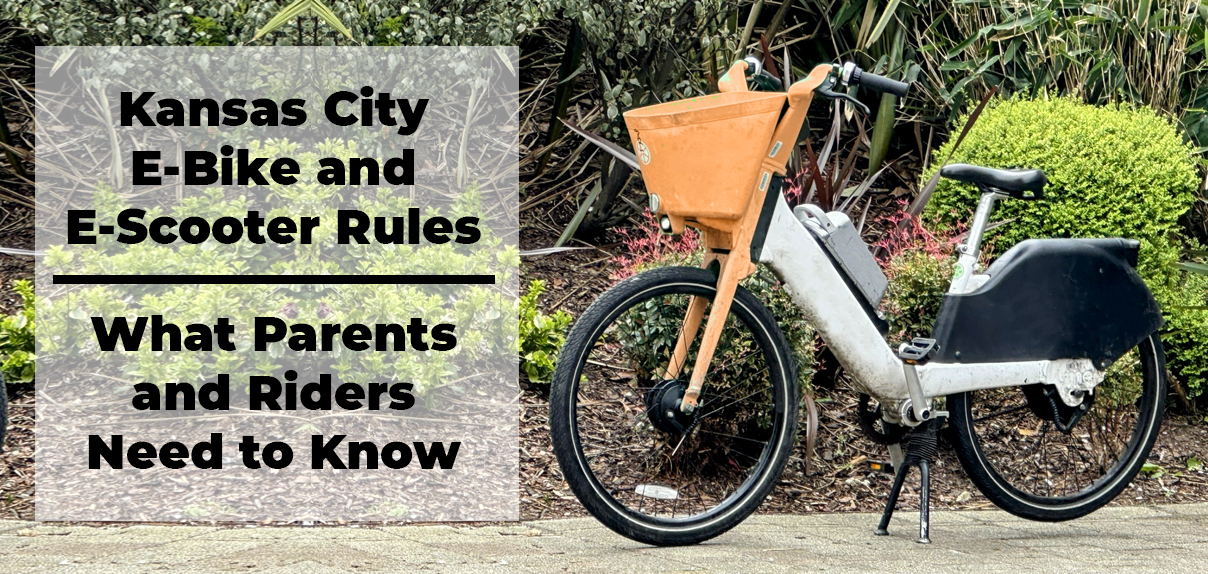
Electric bikes and scooters have quickly become a common sight around the area. They’re convenient, fun and especially popular with teenagers.
But they’re also faster and more powerful than traditional bicycles, and cities across the metro are responding with new rules designed to keep riders, pedestrians and drivers safe.
The tricky part? The rules aren’t the same everywhere.
A teenager riding an e-bike or scooter in Overland Park may face different requirements than a rider in Leawood, Olathe or KCMO. Age restrictions, helmet requirements, speed limits and rules about where these devices can be ridden can all vary.
Let’s break down the key differences in local rules, what parents should check before a child rides and why the type of device matters after a crash.
Why Are Cities Changing the Rules?
The changes are happening because they are needed. As e-bikes and e-scooters have become more popular, communities across the area have seen an increase in police complaints, crashes and serious injuries involving these devices. Sadly, in the most serious cases, crashes have been fatal and involved young riders.
Those incidents have raised concerns about speed, inexperienced riders, traffic safety and where these devices should be allowed to operate. As a result, cities throughout the area are revisiting how these devices can be used safely in public spaces.
First: Know What Your Child Is Riding
Not every electric two-wheeled vehicle is legally the same.
E-Bikes
Kansas and Missouri both use a three-class system:
- Class 1: The motor provides assistance only while the rider is pedaling, up to 20 mph.
- Class 2: The motor can propel the bike without pedaling, up to 20 mph.
- Class 3: The motor provides pedal assistance up to 28 mph.
In both Kansas and Missouri, riders must be at least 16 to operate a Class 3 e-bike.
E-Scooters
- E-scooters are treated separately from e-bikes under local laws.
- They do not use the three-class e-bike system, so scooter rules can change from city to city.
Before your child rides, know what type of device they have and what the local rules allow. Since rules can change, check with the city for the most current information.
Key things to look for include helmet requirements, minimum ages, speed limits, sidewalk and trail restrictions, and how the device is classified. The summaries below are meant as a starting point, not a substitute for checking the applicable ordinance or city guidance.
City-by-City Rules at a Glance
Overland Park
E-Bikes
- Follows Kansas’ Class 1, Class 2 and Class 3 e-bike system
- E-bikes manufactured after January 1, 2023, must have a permanently affixed label designating the class, top assisted speed and motor wattage
- It is illegal to “jailbreak” or modify an e-bike to bypass speed caps
- Class 3 riders must be at least 16 years old
- Riders under 18 must wear helmets
- May be ridden on city streets, sidewalks and trails, subject to local rules
E-Scooters
- Riders under 18 must wear helmets
- Cannot exceed 15 mph
- Not permitted on streets with posted speed limits of 35 mph or higher
In short: In Overland Park, riders under 18 need helmets, Class 3 riders must be 16, and scooters are capped at 15 mph.
Source: https://www.opkansas.gov/scooters-and-bikes
Leawood
E-Bikes + E-Scooters
- Helmet required for riders under 18
- Applies on streets, sidewalks, trails and other public areas
- $25 fine for violations, with an initial emphasis on education and warnings
In short: If a rider under 18 is using an e-bike or scooter in Leawood, they need a helmet.
Source: https://www.leawood.org/570/E-Bike-and-Scooter-Safety
Prairie Village
E-Bikes
- Helmet required for riders under 18
- Class 1 and Class 2 e-bikes are permitted on sidewalks with proper caution
- Class 3 e-bikes must be ridden on the roadway, and riders must be 16 or older
- Riders must yield to pedestrians, give an audible warning before passing, and avoid distracted riding
E-Scooters
- Helmet required for riders under 18
- Riders must yield to pedestrians
- Riders must give an audible warning before passing
- Distracted operation is prohibited
In short: In Prairie Village, Class 3 e-bikes stay on the road, riders under 18 need helmets, and everyone must yield to pedestrians.
Source: https://www.prairievillageks.gov/609/eBikes-eScooters
Olathe
E-Bikes + E-Scooters
- Helmet required for riders under 18
- Both are subject to 15 mph on sidewalks
- Both must have proper lighting and be visible to ride at dusk or at night
- Must yield to pedestrians
- E-scooters cannot be ridden on roads unless the speed limit is 30 mph or under and there is no sidewalk
- E-bikes may be ridden on roads with speed limits up to 40 mph
In short: In Olathe, riders under 18 need helmets, sidewalk riding is capped at 15 mph, and scooters face tighter road limits.
Source: https://www.olatheks.gov/home
Lenexa
E-Bikes – Class 1 & 3
- Riders must be at least 15
- Permitted on sidewalks, trails, streets and parks
- Maximum speed is 20 mph
- Motors may be up to 750 watts
- May be ridden after dark only if equipped with lights
- Not permitted on highways without a valid driver’s license
E-Scooters
- Riders must be at least 14
- Maximum speed is 15 mph
- Permitted on sidewalks, recreational trails and streets with posted speed limits of 25 mph or less
- May be ridden after dark only if equipped with lights
- Not allowed in parks unless riders dismount and walk the device
In short: In Lenexa, check the rider’s age, the device’s speed, and where it is allowed before riding.
Source: https://www.lenexa.com/City-Services/Streets-Transportation-Traffic/E-wheel-Safety-Rules
Fairway
E-Bikes
- Class 1, 2 and 3 are allowed; motors must be under 750 watts
- Class 1 & 2: Maximum assisted speed 20 mph
- Class 3: Maximum assisted speed 28 mph and riders must be 16 or older
E-Scooters
- Follow bicycle traffic rules and must be operated safely around pedestrians
- Riders under 15 must be supervised by an adult or licensed driver
- All e-scooter riders under 18 must wear a helmet
Both
- Highways: E-scooters cannot be ridden on interstate, federal or state highways, but may cross them
- Safety: Riders must yield to pedestrians and give an audible warning when passing
In short: In Fairway, riders need to watch age limits, helmet rules, speed caps, and pedestrian safety.
Source: https://fairwaykansas.org/
Kansas City, Missouri
E-Bikes
- Follow bicycle rules and may ride where bicycles are permitted
- Riders under 16 cannot operate a Class 3 e-bike
- Riders must be at least 16 to operate devices capable of traveling 20 mph or faster
E-Scooters
- Riders must yield to pedestrians and follow the same basic traffic rules as bicycles
Both
- Speed: 15 mph max on sidewalks; 20 mph max on bike lanes, trails and multi-use paths; streets follow the posted speed limit
- Helmets: Anyone under 18 must wear a helmet when riding an e-bike or micromobility device
- Interstate highways: E-bikes and micromobility devices are not permitted on interstate highways
In short: In KCMO, riders under 18 need helmets, sidewalk speeds are limited, and pedestrians get the right-of-way.
Source: https://clerk.kcmo.gov/LegislationDetail.aspx?ID=8038493
*Kansas City, Missouri recently passed updated e-bike and micromobility regulations that take effect later this year.
Lee’s Summit
E-Bikes
- Class 1, 2 and 3 are allowed and generally follow bicycle traffic rules
- Class 1 & 2 e-bikes assist up to 20 mph; Class 3 up to 28 mph
E-Scooters
- Follow applicable bicycle traffic rules and yield to pedestrians
Both
- Helmets: Follow Missouri’s applicable helmet requirements
- Safety: Follow traffic signals, signs and other rules that apply to bicycles
In short: In Lee’s Summit, treat e-bikes and e-scooters like bicycles: follow traffic rules, watch your speed, and yield to pedestrians.
Source: https://cityofls.net/police-department/public-information/e-bike-and-e-scooter-regulations
Here’s Another Thing You Should Know: E-Motos
Some electric dirt bikes and high-powered devices marketed to teenagers — including certain Sur-Ron and Talaria-style vehicles — may not actually qualify as e-bikes. Depending on the vehicle’s specifications, it may instead be classified as a motorcycle or another type of motorized vehicle.
That distinction matters. A vehicle that isn’t considered an e-bike may have very different requirements for age, licensing, registration, insurance, and where it can be ridden.
Before purchasing one for a child, take a few minutes to check the vehicle’s specifications and classification. Don’t assume that because it’s marketed as an “e-bike” or looks like one, it follows the same rules as an e-bike.
Take a look at the bike’s frame. If it was manufactured after January 2023, it should have a permanently affixed factory label identifying its e-bike class, top assisted speed, and motor wattage. If that label isn’t there, that’s a good reason to stop and find out more before letting your child ride it.
What Parents Should Check Before Their Child Rides
You don’t have to memorize every city ordinance. But before your child rides, check these five things:
- What is it? Is it a Class 1, 2 or 3 e-bike? An e-scooter? An e-moto?
- How fast can it go? A device capable of 28 or 30 mph may be subject to very different rules than one limited to 15 or 20 mph.
- How old does the rider have to be? Age requirements vary depending on the device and the city.
- Is a helmet required? Even where one isn’t legally required, a properly fitted helmet is an important safety precaution.
- Where can it be ridden? Sidewalks, trails, bike lanes and roadways may have different rules.
The Bottom Line
E-bikes and e-scooters aren’t going away — and neither are the questions about how they should be regulated.
As more children and teenagers use these devices, communities are responding with rules addressing age, speed, helmets, and where e-bikes and scooters can be ridden.
For parents, the important thing is to know what your child is riding, understand the rules where they are riding it, and make safety a priority.
If a serious crash does occur, those rules may also play an important role in understanding what happened and who may be responsible.
If you or your child has been seriously injured in an e-bike, e-scooter, or other electric vehicle crash, an experienced personal injury attorney can help investigate what happened, help determine whether others may be responsible, and explain your legal options.