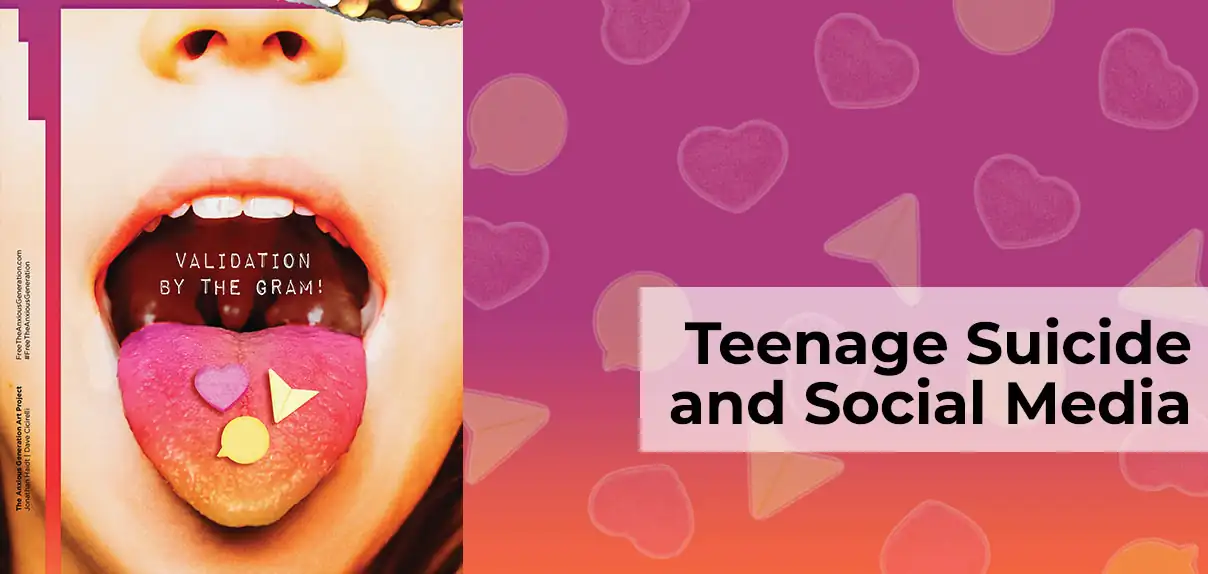
As a father of two teenage daughters, I’ve grown increasingly alarmed by how often we hear about their high school friends or acquaintances who have hurt themselves—or, tragically, taken their own lives. It is heartbreaking and deeply confusing. These are bright, capable kids from supportive families. They attend excellent schools, are well-educated, and have access to countless opportunities. On the surface, they seem to have it all—popularity, success, and happiness. And yet, something is clearly wrong.
Statistics show increasing levels of suicide, anxiety and depression in teenagers in alarming fashion. Why?
With the rise of technology, childhood has shifted—from playing outside with friends to spending hours glued to smartphones. We’ve slowly come to accept, even expect, that it’s normal for teenagers to retreat into their rooms for hours at a time. As parents, we may wonder: What are they doing in there? The quick answer is usually the same—they’re on their devices. But dig a little deeper, and you’ll likely find them endlessly scrolling through social media feeds. These platforms aren’t just harmless distractions—they’re engineered to captivate. They’re designed to feel socially essential. They’re built to consume time, attention, and identity. The platform’s algorithms are fine-tuned to keep kids scrolling, swiping, and craving more. In short, they are designed to be addictive.
If I told you that your teenager was locked in their room engaging in any other addictive behavior—smoking, vaping, using drugs, gambling, or watching pornography—you’d likely act immediately to stop it. Yet when it comes to excessive, compulsive social media use, many of us look the other way. Why? Because it’s socially accepted—and largely unregulated. But that doesn’t make it harmless. Social media companies bear a profound responsibility: to protect young users from addictive and predatory designs; to stop luring them into endless, dopamine-driven content loops; and to refrain from exploiting their data for profit. Our children are not commodities, and their well-being should never be up for sale.
Navigating the teenage years is hard enough without the lures of technology. Do you remember the struggles of your teenage years? You probably compared your physical appearance to that of your peers. What if social media had been at your fingertips during those formative years? You would have compared yourself not only to your peers, but to all the prettiest influencers around the world. You would have felt more ashamed of your body. The more you searched, the more you would have been fed images of unattainable perfection, making you feel even worse about yourself. The algorithms would feed you a steady stream of flawless bodies and filtered perfection, reinforcing the lie that you’re not good enough. And over time, you’d start to believe it.
My oldest daughter went off to college last year. When she made her college decision, she joined an Instagram group for other freshmen entering that college. She proudly showed me the Instagram page and allowed me to scroll through it. I was shocked. The females introduced themselves by posting pictures wearing their prettiest outfits—many in skimpy bikinis—and talking about their interests and what they plan to do in college. A handful of hunky males—some without shirts—relayed their jock interests and anticipation of hanging out with friends in their next chapter of life. But the most disturbing part was the number of “likes” each incoming freshman had in response to their introductory post and the direct correlation to their physical appearance. In other words, the prettiest/hunkiest people received the most “likes.” The likes were compounded when someone was scantily clad, like wearing a bikini in their introductory picture. This is how social circles are now defined. In fact, before I traveled over a thousand miles to drop my daughter off at college, and before she even met the other incoming freshman pictured on that Instagram page, she described them as her “friends.”
Based on sites like these, it is no wonder that, according to internal Meta documents, 41% of teen Instagram users began feeling “unattractive” when using the social media platform; 32% of teenage girls said that when they felt bad about their bodies, Instagram made them feel worse; and 13.5% of teenage girls said Instagram exacerbated their thoughts of suicide and self-injury. These numbers are astonishing and explain why it is so much more difficult to be a teen today in the age of smartphones and social media than it was just 25 years ago. Those born in the late 1990s are trailblazers, navigating puberty in a digital landscape, making Generation Z the first to be constantly engaged with digital devices during this formative period.
From 2010 to 2015, American teenagers transitioned their social lives to smartphones, enjoying uninterrupted access to social media. This fundamental shift in childhood experiences significantly contributed to the rise of mental health issues among adolescents beginning in the early 2010s.
The launch of the iPhone 4 in June 2010, featuring a front-facing camera, along with the introduction of similar capabilities by Samsung and the creation of Instagram as a smartphone-exclusive app, fueled this transformation. The advent of the front-facing camera made taking selfies easier, while the swift growth of high-speed internet enhanced information consumption. By the early 2010s, social “networking” had transformed into social media “platforms,” primarily created to foster public displays seeking validation from both friends and strangers.
Then, the algorithms used to attract teenagers to these platforms became all consuming. Most adults cannot escape it, and teens are even less likely to escape it than adults. These algorithms have surfaced in the bleakest of ways, such as when the parents of 14-year-old Molly Russel found their daughter dead, hanging in her bedroom. When her father started to look at her web browsing history shortly after her suicide, he learned she was pushed thousands of graphic photos and videos relating to suicide, depression and self-harm. Some of the platforms kept feeding her account even after her death!
The critical period for cultural learning occurs between ages 9 and 15 years old, coinciding with many receiving phones and moving social lives online. In addition, increased parental caution has kept children at home, prompting them to turn to devices for engagement. In turn, this has led to a shift from play-based childhood to phone-driven experiences at an age when free play is crucial for physical and social development and fostering community connections.
On average, young individuals receive nearly 200 notifications from social media apps each day, making it difficult for them to maintain focus. Adolescents, with their still-developing frontal cortices, are especially susceptible to distractions, which can impede their concentration. This highlights the importance of schools adopting phone-free policies. The idea of genuine multitasking is a fallacy; we only shift our attention from one task to another, resulting in lost time. A childhood heavily influenced by smartphones may interfere with the development of executive function. In essence, smartphones are kryptonite to our attention.
In addition, the smartphone provides a constant influx of dopamine to this connected generation. While the release of dopamine can be pleasurable when engaging in social media, it ultimately fails to provide genuine fulfillment. Instead, it intensifies the craving for more of the source that elicited that release. This, in turn, can lead to a cycle of addiction and depression.
Consequently, social media presents an ironic dilemma: while it promises connection, it often leads to loneliness and depression. This is especially true among girls.
Although today’s teens have more social connections, the quality and protective nature of these connections have declined. The happiest girls are not necessarily those with the most friends, but rather those who maintain a few strong, supportive friendships, even if it’s just one exceptional friend. As girls increasingly gravitate toward social media platforms, they engage less in meaningful conversations with close friends, finding themselves surrounded by a vast number of transient, unreliable “friends,” followers, likes, hearts and acquaintances. This shift from quality to quantity has contributed to rising feelings of loneliness.
Even if we could effectively filter out harmful content on these platforms, their addictive nature significantly limits the time kids have for real-world, in-person interactions. The effect is so significant that we should view smartphones and tablets in children’s hands as barriers to real-life experiences. Life on these platforms forces young individuals to become their own brand manager, constantly weighing the social implications of every photo, video, comment, and emoji they post.
Laws and Litigation
Historical precedents demonstrate that lawmakers can effectively address threats, as seen with vehicle safety regulations and aviation recalls. A similar approach is essential to tackle the urgent dangers posed by social media, which stem from unregulated technology that lacks safety standards and accountability. The Children’s Online Privacy Protection Act (COPPA), which was last updated ten years ago, needs reform to enhance the protection of children’s online privacy. “Children should have the freedom to play and learn online without being persistently tracked by companies eager to collect and profit from their personal data,” stated FTC Chair Lina Khan. “The proposed amendments to COPPA are crucial, particularly in a world where online tools are vital for everyday life, and companies are employing increasingly sophisticated digital techniques to monitor children.”
Litigation in federal court, specifically, MDL 3047, teed up several novel legal issues: Can social media platforms even be considered “products” so that products liability principles apply to them? Can social media platforms be held liable for the design of their platforms, notwithstanding 47 U.S.C. §230, a statute some have interpreted as a blanket immunity shield? How do tort claims asserted against social media companies intersect with the First Amendment, and does the right to free speech shield not just the content posted online but also the corporate conduct of online platforms? What duty, if any, does a social media platform owe to child users and their parents?
If you’re concerned about the mental health crisis affecting today’s youth and want to be part of a meaningful push for solutions, we invite you to stay informed and take action by visiting www.anxiousgeneration.com.[1]
Our firm is investigating cases involving teenagers who have taken their lives due to social media. If you have lost a child to suicide connected to the harmful effects of social media—or if you know someone who has—please reach out. We want to help. Contact our office to speak with an attorney about your experience, your rights, and how your voice can contribute to this growing call for accountability and change.
[1] Much of the data in this article was provided by The Anxious Generation, Haidt, J. (2024). We appreciate the work Mr. Haidt is doing in this area.